
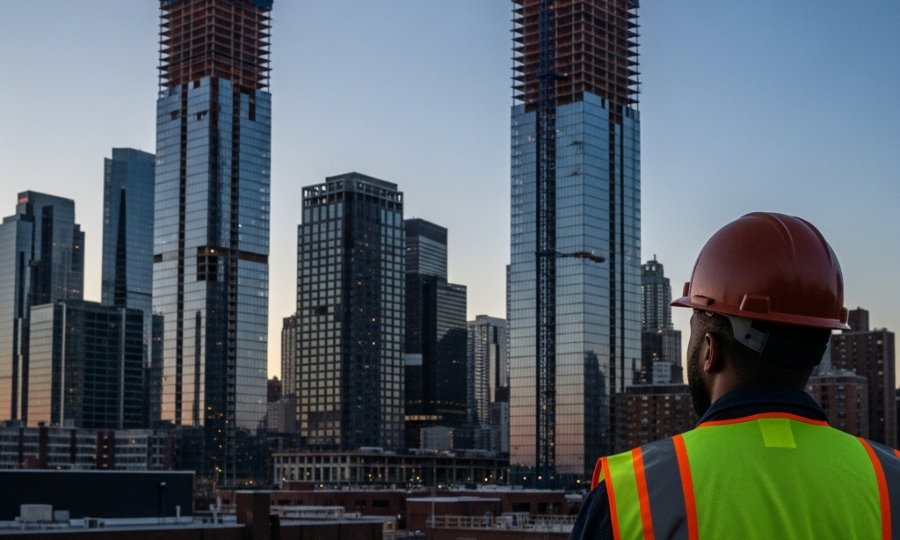
Construction sites across the Bronx are symbols of progress, shaping our neighborhoods and building our future. However, this vital work carries inherent dangers for the dedicated men and women who build our city. Recent reports from the New York City Department of Buildings (DOB) reveal a troubling paradox. While overall construction injuries have declined, the number of fatalities has unfortunately risen. Our Bronx personal injury lawyers understand the profound impact these tragedies have on families and communities across the borough.
Key Takeaways
- New York City Department of Buildings data shows construction-related injuries declined in 2025 to their lowest recorded level, but fatalities paradoxically rose to 10 from 7 in 2024.
- Falls from elevation remain the leading cause of construction fatalities across all boroughs, emphasizing the critical need for strict fall protection measures.
- Systemic issues like reduced OSHA inspections, lower average fines for fatalities, and DOB staff vacancies contribute to persistent safety risks on construction sites.
- New York Labor Law Section 240, known as the ‘Scaffold Law,’ holds property owners and general contractors strictly liable for gravity-related construction accidents due to inadequate safety equipment.
The DOB’s annual Construction Safety Report offers crucial insights into these trends. In 2024, the city recorded 638 construction-related incidents, with 482 people injured and seven workers killed. These figures represented a notable improvement, as injuries dropped by 30 percent and incidents fell by 24 percent compared to 2023. Fatalities, at seven, remained at a ten-year low during that period.
A Concerning Shift in 2025 Safety Data
Despite the positive trends observed in 2024, the landscape shifted significantly in 2025. The DOB reported a further reduction in overall incidents and injuries. Specifically, incidents dropped to 432, a 32 percent decrease from 2024, and injuries fell to 320, a 34 percent reduction from 2024. This marks the lowest number of construction-related injuries on record.
However, this encouraging decline in injuries was overshadowed by a concerning rise in fatalities. Building construction-related deaths increased to 10 in 2025, up from seven in the previous year. This upward trend in fatalities, despite fewer overall injuries, demands urgent attention. It highlights a critical need to re-evaluate safety measures and enforcement strategies on construction sites, particularly in areas like the Bronx.
Falls Remain the Deadliest Hazard
Year after year, falls from elevation consistently rank as the leading cause of construction-related fatalities and serious injuries in New York City. These preventable accidents often involve scaffolding, ladders, unprotected floor openings, and roofs [cite: 3 from previous search, 4 from previous search]. A single misstep or a failure in safety equipment can have catastrophic consequences.
The Occupational Safety and Health Administration (OSHA) sets clear standards for fall protection. For instance, OSHA regulation 29 CFR 1926.501 requires fall protection systems for construction workers at heights of six feet or more above a lower level. These systems include guardrails, safety nets, and personal fall arrest systems. Employers must also provide proper training on fall hazards and the correct use of fall protection equipment.
The Broader Picture from NYCOSH
The New York City Department of Buildings data focuses primarily on building construction. However, the New York Committee for Occupational Safety and Health (NYCOSH) provides a broader perspective through its annual Deadly Skyline report. NYCOSH incorporates data from various sources, including the Bureau of Labor Statistics, the New York State Department of Labor, and OSHA, covering all construction sectors. Their figures often present a more comprehensive, and often starker, reality.
For example, in 2024, NYCOSH reported 55 construction worker deaths across New York State, with 19 fatalities occurring in New York City alone. While these numbers were a decrease from 74 statewide and 30 in NYC in 2023, the overall fatality rates remain alarmingly high. A construction worker in New York City is more than six times as likely to suffer a fatal workplace incident compared to the average worker citywide. This significant disparity underscores the persistent dangers within the industry.
Systemic Failures Fuel the Danger
Several systemic factors contribute to the ongoing risks faced by construction workers. One major concern is the decline in regulatory oversight. OSHA inspections in New York State fell by 29 percent from 2019 to 2025 [cite: 3 from previous search, 19]. This reduction in enforcement allows some contractors to take greater chances with worker safety, prioritizing speed and cost savings over human lives.
Also, the penalties for safety violations often fail to deter negligent practices. The average OSHA fine for a construction fatality dropped to $25,295 in 2024, the lowest since 2017. Such low fines do not provide a strong enough incentive for contractors to invest adequately in safety measures. Additionally, the DOB itself faces staffing challenges, with a vacancy rate of 12.6 percent as of April 2026 [cite: 3 from previous search]. Fewer investigators limit the agency’s capacity for proactive inspections and comprehensive oversight.
Disproportionate Risks for Vulnerable Workers
The data also reveals disturbing disparities in who bears the greatest risk on construction sites. Non-union workers account for a disproportionately high percentage of fatalities. In 2024, 81 percent of OSHA-investigated construction deaths in New York occurred on non-union sites. Unionized environments often provide more extensive safety training, stronger hazard reporting mechanisms, and greater accountability, which can lead to safer working conditions [cite: 19, 20 from previous search].
Latinx workers also face elevated risks. In 2024, Latinx individuals constituted 25.8 percent of all worker fatalities in New York State, despite making up only 18.6 percent of the state’s workforce. Language barriers, job insecurity, and fear of retaliation can make these workers particularly vulnerable to exploitation and unsafe practices. These factors highlight the urgent need for targeted outreach and stronger protections for all construction workers.
Legal Protections for Injured Workers
New York State has robust laws designed to protect construction workers, particularly those involved in elevation-related tasks. New York Labor Law Section 240, often called the “Scaffold Law,” is a critical piece of legislation. This law imposes absolute liability on property owners and general contractors when workers are injured in gravity-related accidents due to inadequate or missing safety devices. This means that if a worker falls from a height because proper protection was not provided, the owner or contractor can be held liable, regardless of the worker’s own conduct.
Also, New York Labor Law Section 241(6) requires owners and contractors to comply with specific safety rules outlined in the State Industrial Code. Violations of these rules can also lead to third-party liability claims. These laws provide avenues for injured workers to seek compensation beyond workers’ compensation, covering damages such as medical expenses, lost wages, and pain and suffering.
The Role of an Accident Attorney in the Bronx
When a construction accident occurs, the aftermath can be overwhelming. Injured workers and their families face mounting medical bills, lost income, and the emotional toll of a serious injury or loss. This is where an experienced accident attorney in the Bronx becomes an invaluable ally. They navigate the complex legal landscape, investigating the incident, identifying responsible parties, and building a strong case to secure the compensation victims deserve.
An attorney will meticulously review accident reports, safety logs, and any evidence of OSHA violations to establish liability. They understand New York’s specific labor laws and how to apply them effectively. Their goal is to ensure that negligent parties are held accountable and that injured workers receive fair treatment. This legal support is crucial for protecting workers’ rights and helping them rebuild their lives after a devastating incident.
Preventative Measures and Accountability
Reversing the trend of rising fatalities requires a multi-faceted approach. First, there must be increased regulatory enforcement. This includes more frequent and thorough inspections by both OSHA and the DOB. Second, penalties for safety violations must be substantial enough to act as a genuine deterrent, rather than a mere cost of doing business. Third, contractors and property owners must prioritize safety over profits, investing in proper training, equipment, and safety protocols.
Local Law 78 of 2017 mandates that site owners, general contractors, and subcontractors report fatalities and significant injuries to the DOB within three business days. This reporting requirement aims to increase transparency and accountability within the industry. By adhering to these regulations and fostering a culture of safety, we can work towards a future where every construction worker returns home safely at the end of their shift.
Seeking Justice with an Experienced Bronx Injury Lawyer
The paradox of declining injuries but rising fatalities on Bronx construction sites is a stark reminder of the ongoing challenges in worker safety. Behind every statistic is a human story of struggle and loss. If you or a loved one has been affected by a construction accident, you do not have to face these challenges alone.
An experienced Bronx injury lawyer can provide the legal guidance and representation you need. Our firm is dedicated to fighting for the rights of accident victims, holding negligent parties accountable, and securing the maximum compensation allowed by law. We are committed to ensuring that justice is served for hardworking New Yorkers. If you need an experienced Bronx accident lawyer, our firm is ready to fight for you.
Sources
- New York City Department of Buildings — 2025 Construction Safety Report
- Occupational Safety and Health Administration (OSHA) — OSHA Fall Protection Standards for NYC Construction Workers
- NYC.gov — How to Report Worksite Incidents
- CBS News New York — New York City Department of Buildings launching new task force to identify risky job sites
Related Reading
Frequently Asked Questions
Why are construction fatalities rising in the Bronx despite fewer injuries?
Recent New York City Department of Buildings reports indicate that while overall construction incidents and injuries decreased significantly in 2025, fatalities unfortunately increased to 10 from 7 in 2024. This paradox suggests that while minor incidents may be declining, the severity of accidents that do occur is leading to more tragic outcomes. Falls from elevation remain the primary cause of these fatal incidents.
What are the main causes of fatal construction accidents in New York City?
Falls from elevation are consistently the leading cause of fatal construction accidents in New York City, accounting for a significant portion of deaths. Other major contributors include being struck by objects, electrocutions, and being caught-in/between hazards, collectively known as OSHA’s ‘Fatal Four.’ [cite: 3 from previous search, 4 from previous search]
How does New York’s ‘Scaffold Law’ protect construction workers?
New York Labor Law Section 240, often called the ‘Scaffold Law,’ provides strong protections for construction workers involved in elevation-related tasks. This law imposes absolute liability on property owners and general contractors if a worker is injured in a gravity-related accident due to a failure to provide proper safety devices like scaffolds, ladders, or harnesses. This means the injured worker does not need to prove negligence in the traditional sense.
What steps can be taken to improve construction site safety in the Bronx?
Improving construction site safety requires a multi-pronged approach. This includes increasing the frequency and thoroughness of regulatory inspections by agencies like OSHA and the DOB, imposing more substantial penalties for safety violations, and fostering a strong safety culture among contractors and property owners. Additionally, ensuring proper training and equipment, especially for fall protection, is crucial.
This article was drafted with AI assistance. Please verify all claims and information for accuracy. The content is for informational purposes only and does not constitute professional advice.
Free Consultation
We want to hear about your case! Fill in the form to speak to a Bronx personal injury attorney now!
Follow us for legal tips and case results:
