
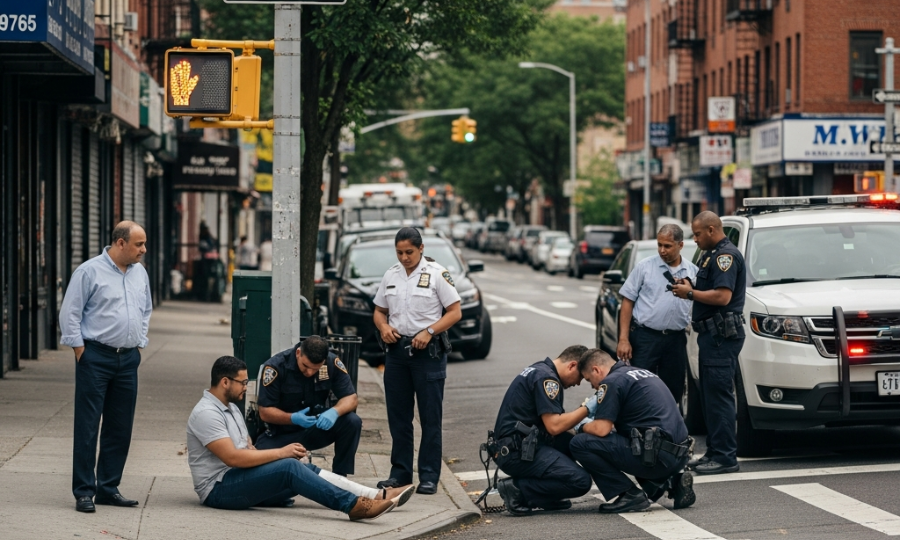
Navigating the aftermath of a street accident in the Bronx can feel overwhelming. Recent changes to New York City traffic regulations have altered how police handle mid-block street crossings. However, civil injury claims operate under distinct legal principles. Our Bronx personal injury lawyers have decades of experience helping accident victims secure fair compensation while guiding them through complex legal changes. This step-by-step guide explains how to protect your civil claim, prove driver liability, and preserve your rights after a pedestrian knockdown in the Bronx.
Key Takeaways
- Local Law 98 of 2024 decriminalized mid-block street crossing in New York City, with the DOT rule taking effect on June 26, 2025.
- Under CPLR Section 1411 pure comparative fault, an injured pedestrian found 30% at fault receives $70,000 from a $100,000 verdict, per Sullivan Papain Block McManus Coffinas & Cannavo P.C.
- Motorists in the Bronx maintain a statutory duty under VTL Section 1146 to exercise due care to avoid colliding with pedestrians upon any roadway, as noted by Lockamy & Associates.
- Decriminalization does not eliminate civil comparative fault defenses, making immediate scene documentation and medical records vital for personal injury claims.
Prerequisites for Protecting Your Pedestrian Claim
Before taking active legal steps, gather essential details related to your accident. Having these items organized will streamline your recovery process.
- Official NYPD police accident report number or precinct details.
- Complete medical records, emergency room discharge papers, and billing statements.
- Clear photographs or video clips of the accident scene, traffic control signals, and road conditions.
- Contact information for eye witnesses who observed the collision.
- Auto insurance details for all involved vehicles.
Step 1: Understand How Local Law 98 Changed NYC Traffic Rules
First, you must understand what changed under municipal law. Local Law 98 of 2024 formally decriminalized jaywalking in New York City by repealing traffic ticket penalties that previously carried fines of up to $250, according to reporting by NPR published in October 2024. Also, legal analysis published by Leandros A. Vrionedes, P.C. in January 2026 notes that a local law amended Section 19-195 of the NYC Administrative Code, but the specific law number and DOT rule citations are unverified.
Consequently, police officers no longer issue criminal summonses to pedestrians who cross mid-block or walk against traffic signals. In addition, NPR reported in October 2024 that NYPD enforcement statistics cited during the bill’s passage showed that 92% of historical jaywalking tickets and 77% of summonses in early 2024 were issued to Black and Latino residents, heavily impacting Bronx communities. While this change removed unfair criminal penalties, civil liability rules remain active.
Pro tip: Never assume that the absence of a police ticket automatically proves the driver was entirely at fault for your injuries.
Step 2: Recognize Why Decriminalization Is Not Automatic Right of Way
Next, differentiate between traffic summonses and civil fault. Under updated NYC Department of Transportation rules, pedestrians may cross streets mid-block or against signals without receiving a police summons, but they are still required to yield right-of-way to oncoming traffic, as detailed by Leandros A. Vrionedes, P.C. in January 2026. Therefore, decriminalization does not grant automatic civil right-of-way to pedestrians.
Plus, legal guidance published by Omrani & Taub in February 2026 confirms that for personal injury claims in the Bronx, decriminalization does not grant automatic civil right-of-way, meaning defense insurers can still assert comparative fault against pedestrians who cross mid-block. Defense lawyers frequently use mid-block crossing to minimize insurance payouts. Consequently, you must build strong evidence showing that the driver had ample time to stop or avoid the collision.
Watch out: Insurance adjusters often misinterpret the new law to convince unrepresented victims that mid-block crossings bar all financial recovery.
Step 3: Document the Scene to Defend Against Comparative Fault
Third, gather physical evidence to defeat comparative fault arguments. Personal injury actions arising from Bronx pedestrian knockdowns remain governed by New York’s pure comparative fault rule under CPLR Section 1411, which reduces damages proportionately rather than barring recovery, according to analysis by Sullivan Papain Block McManus Coffinas & Cannavo P.C. published in January 2026. For example, under CPLR Section 1411, if a Bronx jury finds an injured pedestrian 30% at fault for failing to yield while crossing mid-block, a $100,000 verdict may be reduced proportionately, as demonstrated by Sullivan Papain Block McManus Coffinas & Cannavo P.C. in January 2026.
Therefore, capturing precise scene details is vital. Take photographs of skid marks, traffic signals, sightlines, and street lighting along busy corridors like Grand Concourse, Pelham Parkway, or East Tremont Avenue. Meanwhile, check nearby commercial buildings, bodegas, and apartment complexes for surveillance cameras that may have recorded the incident.
Pro tip: Store physical clothing and damaged personal items worn during the crash in an untouched condition to preserve physical proof of impact speed and angle.
Step 4: Establish Driver Negligence Under Vehicle and Traffic Law Section 1146
Fourth, demonstrate that the motorist failed their legal duty of care. Motorists operating vehicles in the Bronx remain bound by New York Vehicle and Traffic Law (VTL) Section 1146, which requires drivers to exercise due care to avoid colliding with pedestrians upon any roadway, as explained by Lockamy & Associates in March 2025. Consequently, drivers cannot simply state that a pedestrian was outside a crosswalk to escape civil responsibility.
In addition, our injury attorneys in the Bronx examine driver behavior closely. For example, we evaluate whether the motorist was speeding, texting, making an illegal turn, or driving under the influence. Also, drivers must adapt their speed to rain, snow, heavy traffic, and residential neighborhood conditions. Proving a driver breached VTL Section 1146 significantly counters defense claims of pedestrian fault.
Watch out: Motorists often claim they never saw the pedestrian, but failing to keep a proper lookout constitutes negligence under New York law.
Step 5: Avoid Common Insurance Adjuster Traps After a Mid-Block Crossing
Fifth, protect your legal rights during insurance communications. Shortly after a crash, insurance claims adjusters will reach out to request recorded statements. However, adjusters frequently ask leading questions designed to extract statements admitting partial fault or misjudging vehicle distances. Consequently, answering these questions without legal representation can harm your claim value.
Also, insurance companies may offer fast settlement checks before the full extent of your physical injuries becomes clear. As a result, accepting an early settlement releases the negligent driver from all future financial responsibility. Instead, decline to give recorded statements until you consult a legal professional who understands New York pedestrian laws.
Pro tip: Direct all calls from insurance representatives to your legal advocate so your statements are never taken out of context.
Step 6: Gather Key Evidence to Strengthen Your Bronx Pedestrian Claim
Sixth, compile comprehensive documentation supporting your losses. Thorough evidence demonstrates both liability and the extent of your harm. Consequently, work systematically to collect all relevant documentation following your incident.
- Obtain emergency room records and primary care medical charts detailing your diagnosis.
- Request formal 911 dispatch audio logs and police accident report transcripts.
- Secure pay stubs and employer tax forms confirming lost income and lost earning potential.
- Maintain a daily journal documenting pain levels, emotional hardship, and physical limitations.
Plus, request nearby dashcam footage from municipal buses or private vehicles that stopped near the crash scene. Acting quickly ensures crucial digital evidence is preserved before security camera systems overwrite their video files.
Watch out: Delaying medical evaluation allows defense insurance companies to claim your injuries were unrelated to the vehicle collision.
Step 7: Partner with a Qualified Lawyer to Secure Maximum Compensation
Finally, engage skilled legal representation to manage settlement negotiations or court proceedings. Personal injury litigation involves strict procedural rules, court deadlines, and technical evidentiary standards. Also, an experienced attorney will hire accident reconstruction experts, analyze vehicle black box data, and handle complex insurance negotiations on your behalf.
Additionally, your lawyer will calculate full damages including medical bills, future rehabilitation needs, lost income, and pain and suffering. By building a compelling case under New York civil procedure rules, your attorney ensures defense insurers evaluate your claim fairly. Consequently, professional legal counsel maximizes your overall financial recovery.
Summary and Next Steps for Bronx Accident Victims
In summary, Local Law 98 decriminalized jaywalking in New York City by removing traffic fines, but civil rules of negligence remain firmly in place. Pedestrians crossing mid-block must still yield right-of-way, while drivers maintain a legal duty under VTL Section 1146 to exercise due care. Under CPLR Section 1411 pure comparative fault, an injured pedestrian can still recover substantial compensation even if partially at fault.
To protect your recovery, seek immediate medical treatment, document the crash scene thoroughly, preserve electronic evidence, and avoid giving recorded statements to insurance adjusters. If you need an experienced Bronx accident lawyer, our firm is ready to fight for you.
This article was drafted with AI assistance. Please verify all claims and information for accuracy. The content is for informational purposes only and does not constitute professional advice.
Free Consultation
We want to hear about your case! Fill in the form to speak to a Bronx personal injury attorney now!
Follow us for legal tips and case results:
