
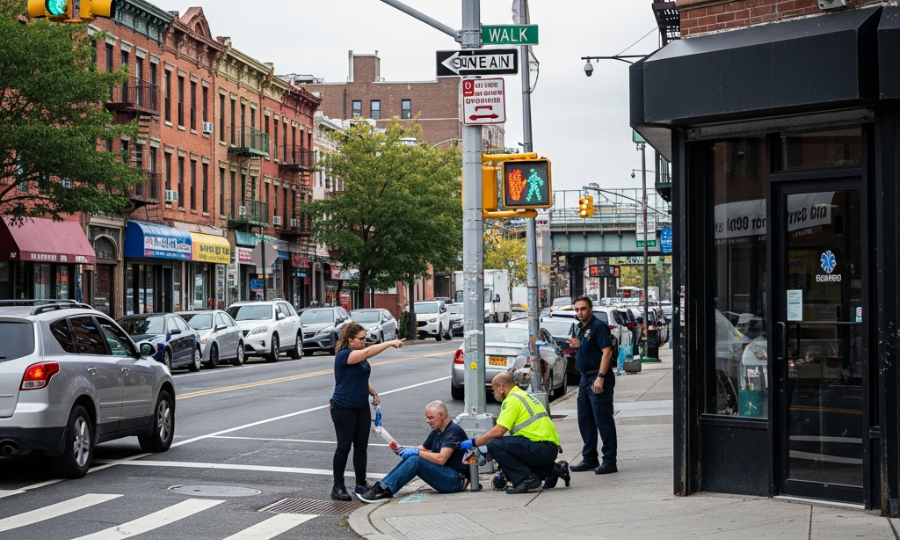
Our Bronx personal injury lawyers have decades of experience helping accident victims secure justice after sudden intersection crashes. Crossing the street safely should never end in a trip to the emergency room. Yet, drivers making left turns at busy Bronx intersections frequently cut corners, rush through signals, and strike pedestrians who have the clear right of way. Defense attorneys and insurance companies often try to shift blame onto victims by claiming the driver had a green light. Proving liability requires a precise step by step approach using official signal timing data and legal standards.
Key Takeaways
- According to the NYC Department of Transportation, left-turning vehicles contribute to a significant portion of turn-related pedestrian deaths in NYC.
- Under New York Vehicle and Traffic Law § 1151, drivers must yield the right-of-way to pedestrians crossing legally in crosswalks when traffic-control signals are not in place or not in operation.
- Public health research indicates that Leading Pedestrian Intervals can reduce overall pedestrian injuries and daylight fatal crashes.
- Attorneys use NYC Open Data signal logs and expert reconstruction to prove drivers violated active WALK signals during LPI head starts.
What You Will Need to Prove Fault
To establish that a turning driver violated your right of way, gathering objective proof early is essential:
- NYC Open Data records: Department of Transportation signal timing charts and Leading Pedestrian Interval (LPI) logs.
- Police Accident Report: The official NYPD report detailing vehicle direction and driver statements.
- Surveillance footage: Video from nearby storefronts, traffic cameras, or dashcams.
- Witness statements: Contact details and written observations from bystanders.
- Medical records: Direct documentation linking your injuries to the timeline of the impact.
Step 1: Understand How Left-Turn Conflicts Happen
Left-turning vehicles present a unique danger to people on foot. According to the NYC Department of Transportation Left Turn Pedestrian and Bicycle Crash Study, left-turning vehicles account for more than twice as many pedestrian fatalities and over three times as many serious injuries as right-turning vehicles in New York City. The physical design of modern passenger cars creates significant blind spots along the driver side windshield frame. Also, drivers making left turns usually execute them at higher speeds across multiple lanes.
According to data from the NYC Department of Transportation, left-turning vehicles contribute to a significant portion of turn-related pedestrian deaths in New York City despite similar overall volumes of left and right turns. When drivers focus solely on finding a gap in oncoming vehicle traffic, they frequently fail to scan the crosswalk where pedestrians are actively walking.
Watch out: Insurance adjusters will often argue that because the driver had a green light, both parties shared equal rights to the intersection. Do not accept this argument without reviewing specific state traffic laws.
Step 2: Establish the Legal Right of Way Under New York Law
Under New York Vehicle and Traffic Law § 1151, drivers are legally required to yield the right-of-way to pedestrians crossing within marked or unmarked crosswalks when traffic-control signals are not in place or not in operation. Even when a motorist turns on a solid green light, their right to proceed is strictly subordinate to a pedestrian who is legally inside the crosswalk with a walk signal in their favor.
Public data indicates that a notable percentage of seriously injured pedestrians in New York City were struck while actively crossing legally with the signal in their favor. Establishing that you stepped off the curb during a valid WALK display establishes a legal presumption of driver negligence.
Pro tip: Our injury attorneys in the Bronx handle car, construction, and slip-and-fall cases by establishing driver statutory violations immediately through formal legal notices sent to defense counsel.
Step 3: Secure Leading Pedestrian Interval Data
Many intersections throughout the Bronx utilize Leading Pedestrian Intervals (LPIs). An LPI gives pedestrians a advance walk signal before parallel traffic gets a green light. This brief window gives walking New Yorkers time to establish position in the roadway before turning vehicles begin moving.
Public health research indicates that Leading Pedestrian Intervals can reduce overall pedestrian injuries and daylight fatal crashes. Additionally, historical NYC DOT crash analysis of 104 intersections treated with LPIs demonstrated a 56% decline in pedestrian and cyclist fatalities and severe injuries caused specifically by left-turning vehicles.
Engineering studies published by the Transportation Research Board show that 3-second LPI implementations can significantly reduce pedestrian-vehicle conflicts for pedestrians departing during the initial phase of the WALK signal. According to an evaluation by the Federal Highway Administration, signalized intersections utilizing Leading Pedestrian Intervals experience a statistically significant reduction in vehicle-pedestrian conflicts by physically separating turning traffic from initial pedestrian entry.
Pro tip: Obtain the precise signal timing database records for the intersection. If the signal featured an LPI, proving you were struck within those first few seconds completely disproves any defense that the driver started turning first.
Step 4: Use Expert Testimony and NYC Open Data Logs
Litigation expert witnesses rely on LPI signal timing records maintained in the NYC Open Data portal, specifically the Motor Vehicle Collisions and VZV Leading Pedestrian Interval Signals datasets, to establish precise time-stamped proof of driver non-compliance during active walk intervals. Expert accident reconstructionists combine these public data sets with physical evidence from the crash scene to pinpoint vehicle speed, impact trajectory, and signal phase.
Expert witnesses can calculate exact walking speeds and vehicle travel distances. By matching these figures against the certified signal timing sequence provided by the Department of Transportation, experts demonstrate to juries that the driver had ample time and visibility to see and avoid the pedestrian.
Watch out: NYC maintains signal-related datasets that are updated, but no evidence shows signal logs themselves change when traffic patterns update. Your legal team must subpoena and preserve historical signal control data corresponding directly to the exact date and minute of your collision.
Step 5: Document Scene Evidence and Blind Spot Obstructions
Physical evidence at the collision site helps defeat common defense strategies. Take detailed photographs of the crosswalk markings, street lighting, curb cuts, and any temporary construction barriers. Record whether parked vehicles blocked sightlines near the corner.
Driver visibility plays a central role in left-turn cases. The vehicle frame, visual distractions, and glare often factor into driver failure to yield. Capturing the scene from the driver prospective height and angle at the exact time of day helps experts reconstruct what the driver should have seen.
Pro tip: Canvas surrounding commercial buildings immediately. Many private business cameras record sidewalk and crosswalk activity, but footage retention varies widely by system; 24-72 hours is one possible range but not universal.
Step 6: Counter Common Comparative Negligence Arguments
Insurance representatives routinely claim that injured pedestrians were distracted by mobile phones or stepped off the curb without looking. In New York, modified comparative fault rules apply for motor vehicle cases, meaning any fault assigned to a victim reduces their overall financial recovery proportional to that percentage, and recovery may be barred if the victim is more than 50% at fault.
To overcome these tactics, your legal team must establish a firm timeline showing you entered the crosswalk cleanly while the signal was in your favor. Demonstrating that the driver failed to exercise due care under New York Vehicle and Traffic Law § 1146 helps counter attempts to shift primary responsibility onto the victim.
Watch out: Never give a recorded statement to the driver insurance adjuster before speaking with a legal professional. Adjusters often ask leading questions designed to trick you into admitting partial fault.
Next Steps After an Intersection Collision
Taking immediate action after a crosswalk injury protects both your legal rights and your physical recovery. Follow these essential steps to secure your claim:
- Seek immediate medical evaluation and follow all treatment recommendations.
- Obtain a full copy of the NYPD Police Accident Report.
- Request and archive signal timing datasets for the specific intersection.
- Consult with experienced legal counsel before discussing the crash with insurance companies.
If you need an experienced Bronx accident lawyer, our firm is ready to fight for you.
Sources
- NYC Department of Transportation, Left Turn Pedestrian and Bicycle Crash Study
- Columbia University Mailman School of Public Health, Leading Pedestrian Intervals and Pedestrian Injury Study in Nature Cities
- Federal Highway Administration, TechBrief on Leading Pedestrian Intervals
This article was drafted with AI assistance. Please verify all claims and information for accuracy. The content is for informational purposes only and does not constitute professional advice.
Free Consultation
We want to hear about your case! Fill in the form to speak to a Bronx personal injury attorney now!
Follow us for legal tips and case results:
