
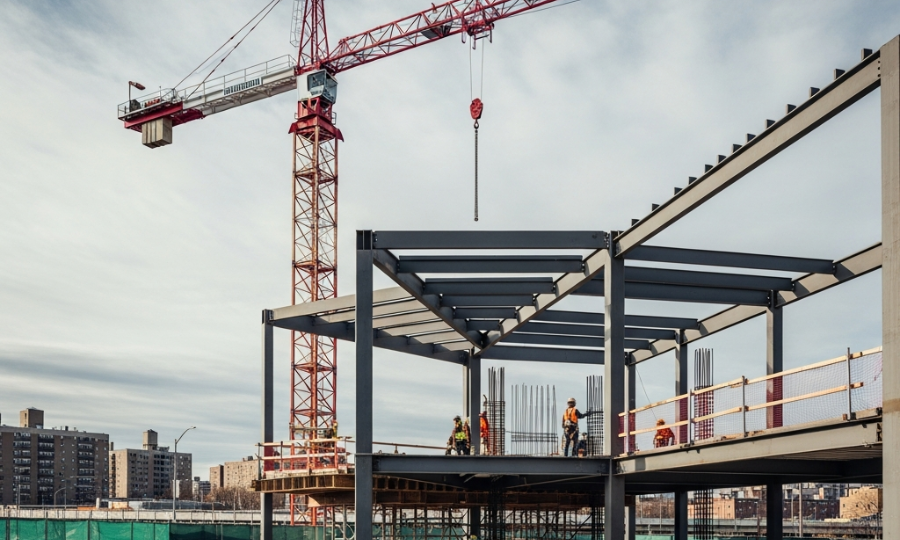
Understanding New York Labor Law Section 240 during Tower Crane Operations
Working on a major construction site in the Bronx carries severe risks every single day. Tower crane operations stand among the most dangerous tasks in the modern building industry. Heavy loads hang high above physical work zones. Structural rigging must withstand massive gravitational force. When crane equipment fails or proper fall protection is missing, catastrophic injuries occur in seconds.
Key Takeaways
- New York Labor Law Section 240 imposes strict, non-delegable liability on property owners and contractors for elevation-related injuries during crane operations.
- Injured workers can receive standard workers’ compensation benefits while simultaneously filing a Section 240 lawsuit to recover damages for pain and suffering.
- Claims against public entities like NYCHA or Port Authority require a formal Notice of Claim within 90 days under General Municipal Law Section 50-e, but Port Authority has separate bi-state notice requirements.
New York Labor Law Section 240, commonly known as the Scaffold Law, offers specialized legal protections for injured workers. This statute addresses gravity-related risks on active job sites. Our Bronx personal injury lawyers have decades of experience helping accident victims secure justice after devastating construction site incidents.
Under New York Labor Law Section 240, property owners and general contractors hold non-delegable, strict liability for elevation-related injuries. As noted by The Paris Law Group in a July 30, 2026 legal guide, this protection applies without requiring proof of negligence and prevents defendants from claiming comparative fault. If you suffer an elevation injury while operating or working near a tower crane, the law stands firmly on your side.
How Elevation Hazards Apply to Heavy Crane Work
Many construction workers assume that Section 240 only applies when someone falls off a physical scaffold. However, the legal scope of the statute covers a much broader range of elevation-related hazards. Tower cranes raise, lower, and suspend multi-ton steel beams, concrete forms, and equipment. Consequently, the gravitational forces involved in crane operations fall directly within the intent of the law.
The statutory language explicitly mandates proper safety devices for height-related work. According to the text of N.Y. Labor Law Section 240, owners and contractors must furnish properly constructed hoists, stays, ladders, slings, hangers, blocks, pulleys, braces, irons, and ropes. When a contractor fails to provide these mandatory safety devices, gravity can cause immediate and life-altering physical trauma.
Also, elevation hazards do not only apply to workers falling from extreme heights. Gravity also acts on suspended loads and rigging equipment. If a crane sling snaps or a hoist fails, falling objects create fatal hazards for everyone working below. The law holds owners accountable for securing both the worker and the materials being moved overhead.
Landmark Legal Precedents Expanding Elevation Protections
New York courts consistently uphold strong protections for workers involved in elevation-related incidents. For example, the New York Court of Appeals established a critical precedent in Runner v. New York Stock Exchange, Inc. (2009). The court ruled that Section 240 protection applies to injuries directly resulting from a physically significant elevation differential, even if the worker did not personally fall or get struck by a falling object.
In the Runner case, workers were lowering a heavy reel down a set of stairs using a rope. The weight of the reel pulled the workers forward, causing severe physical injury. The Court of Appeals determined that gravity-driven force created the harm. Therefore, statutory liability applied even without a direct fall.
Additionally, modern crane cases continue to reinforce these legal standards. In Perez v. Tishman Construction Corporation of New York, a New York court granted partial summary judgment on liability under Section 240. The ruling emphasized that the job site failed to provide a crane, electric pulley, or winch system to properly secure heavy materials at height. These court rulings prove that contractors cannot shortcut site safety when lifting heavy material.
Securing Maximum Recovery Beyond Workers Compensation
When an injury occurs on a Bronx construction site, workers usually file for immediate workers’ compensation benefits. These benefits pay a portion of lost wages and cover basic medical expenses. However, standard benefits do not account for physical pain, mental suffering, or lost long-term career growth.
Fortunately, injured construction workers can pursue a third-party lawsuit under Labor Law Section 240 while simultaneously receiving workers’ compensation benefits. As explained in a January 19, 2026 Scaffold Law report by Richman Law, a third-party lawsuit allows injured crew members to recover substantial financial damages for pain and suffering, which workers’ compensation alone never covers.
This two-track recovery system provides critical financial relief for injured workers and their families. While your workers’ compensation claim covers immediate medical treatment, a direct third-party lawsuit targets the non-compliant property owner and general contractor. An experienced accident attorney in the Bronx navigates both processes to maximize your overall financial recovery.
Real-World Case Example of High-Elevation Recovery
The financial impact of a serious tower crane accident can last a lifetime. Tower crane operators and riggers face daily exposure to high-altitude hazards. Lack of required safety harnesses, perimeter guards, or secure walkways leads to life-changing injuries or permanent disability.
High-elevation recoveries demonstrate the true power of Section 240 claims. For instance, a Bronx crane operator secured a significant pre-trial settlement under Labor Law Section 240. The operator fell into a basement from an unfinished building’s first floor due to a complete lack of required fall protection. This massive recovery highlights how strict liability holds negligent entities fully accountable for unsafe working conditions.
When site management ignores essential safety protocols, devastating falls occur. Our injury attorneys in the Bronx handle car, construction, and slip-and-fall cases with aggressive, relentless dedication. We investigate every angle of the site structure to establish absolute statutory liability against responsible parties.
Common Causes of Tower Crane Incidents in the Bronx
Tower crane operations require precise coordination, rigorous equipment maintenance, and constant oversight. Unfortunately, tight construction deadlines in New York City often lead contractors to cut corners. These careless decisions place workers in immediate danger on major job sites.
Improper rigging ranks among the leading causes of crane accidents. When site crews use worn slings or incorrect hoist blocks, heavy loads swing uncontrollably or drop without warning. Similarly, improper assembly or dismantling of tower crane masts creates severe structural instability. Missing tie-in collars or defective climbing pins can cause catastrophic mast collapses.
Also, dangerous environmental conditions worsen crane hazards. High wind gusts across the Bronx riverfront can alter suspended load dynamics. If site managers fail to halt crane operations during bad weather, suspended cargo becomes a lethal wrecking ball. Contractors must prioritize worker safety over project deadlines every single day.
Identifying Responsible Parties in Heavy Equipment Lawsuits
Crane litigation involves complex layers of contractual relationships. Identifying every liable party is essential for building a strong legal claim. While your direct employer receives immunity from personal injury lawsuits under standard workers’ compensation laws, several other entities remain fully liable under Section 240.
The property owner holds ultimate responsibility for site safety under the law. Property owners cannot escape liability by delegating work to general contractors. Likewise, the general contractor maintains joint responsibility for site safety enforcement. If an owner or contractor fails to supply required safety harnesses, ladders, or mechanical hoists, they face direct liability for resulting harm.
In addition, third-party sub-contractors, crane rental companies, and maintenance vendors may share legal liability. For example, if a third-party rigging company provides defective hoisting straps, they can face additional legal claims. A skilled legal team examines site logs, safety inspection records, and crane maintenance sheets to hold every negligent party responsible.
Crucial Legal Deadlines for Bronx Construction Claims
Timing plays a critical role in preserving your legal rights after a tower crane accident. New York law enforces strict statutory deadlines for personal injury actions. Delaying your legal action can permanently eliminate your right to financial compensation.
Under New York Civil Practice Law and Rules Section 214(5), injured workers generally have a three-year statute of limitations from the date of the incident to bring a personal injury lawsuit against private owners and general contractors under Labor Law Section 240. However, waiting three years is a dangerous strategy. Physical evidence disappears, crane components get repaired, and witness memories fade quickly.
Plus, much shorter deadlines apply if a public entity owns or manages the construction site. The 90-day notice requirement applies to qualifying public corporations under GML 50-e, but Port Authority has separate bi-state notice requirements. Missing this 90-day deadline usually terminates your right to sue the public authority permanently.
Steps to Take Immediately After a Crane Accident
The moments following a job site injury are chaotic, but taking key steps protects your health and your legal claim. First, seek immediate medical attention. Tower crane injuries often involve severe internal trauma, spinal damage, or head injuries that require emergency treatment.
Next, report the incident to your job site supervisor right away. Ensure that management creates an official, written accident report. Take photos and video footage of the accident scene if you are physically able to do so. Capture images of defective crane components, broken slings, missing fall protection harness points, and weather conditions.
Finally, avoid giving recorded statements to insurance adjusters or signing liability waivers before speaking with legal counsel. General contractor insurance reps move fast to minimize financial payouts. Protecting your long-term recovery requires strong legal representation from the start. Finding the best Bronx injury lawyer gives you a powerful advocate against aggressive insurance firms.
How Our Experienced Bronx Legal Team Fights for You
Building a successful Labor Law Section 240 claim requires deep knowledge of New York labor statutes, municipal codes, and heavy machinery operations. Our legal team launch an immediate investigation upon taking your case. We retain certified crane experts, site safety engineers, and medical specialists to prove statutory violations and demonstrate the full extent of your damages.
We handle every aspect of your case while you focus on your physical recovery. We gather OSHA inspection records, secure crane maintenance logs, review site safety meeting minutes, and interview eyewitnesses. We push back against insurance companies that try to blame workers for unsafe site conditions.
You should never have to carry the financial burden of an owner or contractor’s negligence. Our firm operates on a contingency fee basis, meaning you pay zero legal fees unless we successfully recover money for you. We provide clear, confident, and empathetic legal guidance every step of the way.
Take Action to Protect Your Future Today
A tower crane accident can change your life in an instant, leaving you with steep medical bills, physical pain, and severe career disruption. New York Labor Law Section 240 provides powerful legal protections designed to hold negligent property owners and contractors accountable for dangerous elevation hazards.
Do not navigate the legal process alone while facing powerful corporate defendants and insurance companies. You need a dedicated legal team that knows the Bronx, understands job site safety regulations, and fights tirelessly for injured New York workers.
If you need an experienced Bronx accident lawyer, our firm is ready to fight for you. Contact us today to schedule a free, confidential consultation. Let us analyze your case, explain your rights under New York law, and help you secure the full compensation you deserve.
Sources
- New York Court of Appeals, Runner v. New York Stock Exchange, Inc., 13 NY3d 599 (2009)
- New York Supreme Court, Perez v. Tishman Construction Corporation of New York
This article was drafted with AI assistance. Please verify all claims and information for accuracy. The content is for informational purposes only and does not constitute professional advice.
Free Consultation
We want to hear about your case! Fill in the form to speak to a Bronx personal injury attorney now!
Follow us for legal tips and case results:
