
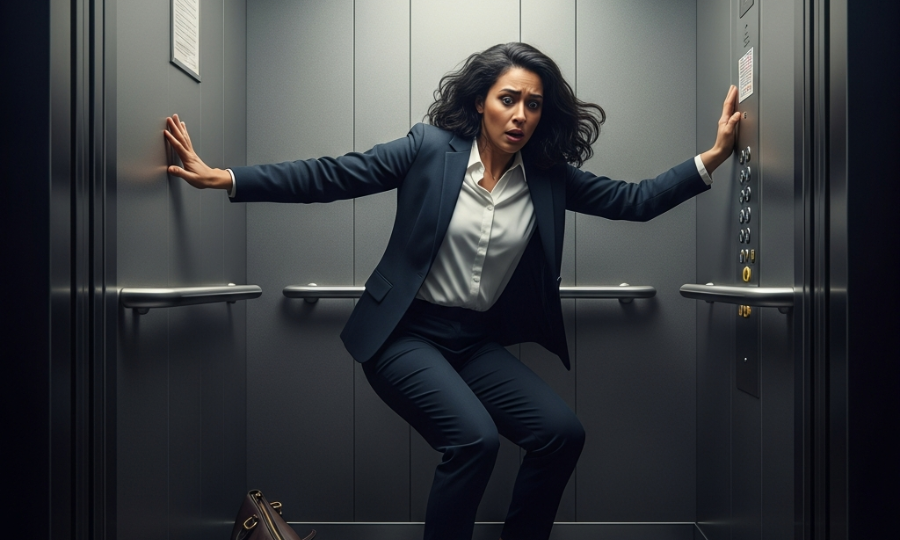
When an elevator suddenly drops several floors before violently jarring to a halt, the terror is immediate. Passengers often believe the car snapped its cables and plummeted in free fall toward the pit. However, mechanical realities in modern high-rise buildings tell a different story.
Key Takeaways
- Modern traction elevators feature multiple redundant steel cables and mechanical wedge safeties that physically prevent Hollywood-style free falls.
- Elevator plunges are typically sudden deceleration events or buffer impacts that generate severe vertical G-forces and axial spinal compression.
- Under NYC Building Code Appendix K Section 3.8.4.1, all single-plunger traction elevators must be retrofitted with dual-plunger brakes or comply with Unintended Car Movement Protection by January 1, 2027.
- The NYC Department of Buildings investigates roughly 100 elevator passenger injury incidents each year across the five boroughs.
Modern traction elevators operate with multi-layered safety systems designed to prevent true unchecked falls. Yet, sudden uncontrolled drops, rapid decelerations, and violent misleveling events cause severe, life-altering injuries every month across New York City. Our Bronx personal injury lawyers have decades of experience helping accident victims hold negligent property managers and elevator service companies accountable when these mechanical failures strike.
The Myth of the Free Fall Versus Elevator Physics
Hollywood movies often depict snapped steel cables sending passengers tumbling down empty shafts. In real modern buildings, technical guidelines explain that high-rise traction elevators are physically engineered against catastrophic free falls. These systems utilize multiple redundant high-strength steel hoist ropes.
Consequently, each individual steel cable possesses enough mechanical strength to hold the entire weight of a fully loaded car on its own. Also, massive counterweights balance the cab’s mass, preventing gravitational runaway. In addition, mechanical overspeed governors continuously monitor car velocity. If a cab exceeds safe operating limits, the governor instantly trips heavy wedge-action safeties that physically clamp onto the vertical steel guide rails in the hoistway.
Therefore, total cable failure causing an uninhibited plunge is virtually non-existent in modern structures. Nevertheless, what riders actually experience during a plunge is terrifying, violent, and medically destructive.
What Actually Happens During an Elevator Plunge
Case investigations by Block O’Toole & Murphy involving sudden drop incidents show that perceived free falls are typically rapid deceleration events or electrical fault trips. When an electrical fault occurs, the drive brake system drops instantly, abruptly arresting the elevator’s downward motion. In other situations, a malfunctioning cab slides past its designated landing and impacts the oil or spring buffers in the pit at the base of the hoistway.
Commercial office towers in Midtown and Downtown Manhattan operate high-speed traction cabs moving at significant speeds.
According to litigation findings documented by Wingate, Russotti, Shapiro, Moses & Halperin, LLP involving a 1.1 million dollar settlement at One New York Plaza, sudden emergency deceleration from normal operating speeds generates extreme vertical G-forces. These violent deceleration forces inflict permanent spinal trauma even when passengers never touch the cab walls.
Similarly, a case in Bronx County Supreme Court involved a settlement after a freight elevator bottomed out onto pit buffers. The rapid stop compressed the passengers’ intervertebral discs and delivered massive axial loads straight through the musculoskeletal system, demonstrating the catastrophic physical consequences of buffer impacts.
Severe Musculoskeletal Injuries Caused by Rapid Deceleration
When an elevator drops out from underneath you and stops abruptly, your body absorbs thousands of pounds of upward reactive force. In rapid-stop accidents, severe vertical kinetic energy compresses the spine instantaneously. Consequently, victims often suffer debilitating physical trauma that permanently diminishes their quality of life.
Our injury attorneys in the Bronx handle car, construction, and slip-and-fall cases, as well as complex building liability claims involving the following common elevator trauma patterns:
- Herniated and Ruptured Discs: Extreme axial loading forces the spinal discs to bulge or rupture outward into the spinal canal. This tears outer spinal ligaments and puts crushing pressure on the spinal cord.
- Nerve Impingement and Radiculopathy: Dislodged disc material pinches critical nerve roots. As a result, victims suffer shooting pain, numbness, tingling, and motor weakness in their legs or arms.
- Spinal Fusion Surgeries: Conservative physical therapy and epidural steroid injections frequently fail to relieve severe disc displacement. Consequently, surgeons must perform anterior cervical discectomies, laminectomies, or multi-level lumbar fusions to stabilize the spine.
- Severe Cervical Whiplash: The violent upward deceleration whips the neck violently back and forth. This motion strains cervical muscles, damages facet joints, and causes chronic occipital headaches.
- Lower Extremity Fractures: If an elevator bottoms out directly onto the pit buffers, the impact can fracture the calcaneus, break ankles, or tear meniscus tissue in the knees.
NYC Building Codes and Elevator Safety Inspections
To protect the public from sudden drops, the NYC Department of Buildings enforces rigorous annual testing. Per NYC Department of Buildings inspection guidelines, Category 1 no-load safety inspections are conducted annually and Category 5 rated-load speed safety tests are performed every five years, with reports filed with DOB by qualified parties.
Also, the NYC Department of Buildings established a strict safety mandate under NYC Building Code Appendix K, which incorporates ASME A17.3 standards. Under Chapter K3, Section 3.8.4.1 of this code, building owners must retrofit all existing traction elevators equipped with single-plunger brakes by January 1, 2027. Property owners must install dual-plunger brake assemblies or Unintended Car Movement Protection systems, such as rope grippers, to prevent uncontrolled motion.
According to NYC Department of Buildings official safety statistics released on November 14, 2023, mechanical in-service passenger fatalities remain exceedingly rare. However, the DOB Elevator Unit investigated 100 accidents where at least one person was injured in 2023, but the specific causes of ‘sudden mechanical malfunctions and rapid mislevelings’ are not documented in the provided sources.
Proving Negligence in Bronx Elevator Accident Claims
When an elevator fails in a residential complex in the South Bronx, a commercial building along the Grand Concourse, or a high-rise in Manhattan, multiple entities may share legal responsibility. To build a strong personal injury claim, your legal team must uncover why the mechanical components failed to operate safely.
First, property owners in New York have a duty to maintain premises in a reasonably safe condition, but whether this duty is non-delegable depends on the specific property type and circumstances. When landlords ignore tenant complaints about shuddering cars, jerky landings, or strange grinding noises, they expose themselves to substantial legal liability. Second, third-party elevator maintenance contractors face direct liability if their technicians fail to properly service hoist brakes, adjust governor cables, or inspect traction sheaves during scheduled visits.
Case settlements summarized by Gair, Gair, Conason and colleagues across New York and Bronx County Supreme Courts indicate that multi-floor sudden-drop personal injury claims involving spinal fusions and nerve compression can result in significant compensation. These substantial outcomes occur when discovery records establish that building management or maintenance vendors ignored documented brake defects and electrical controller faults.
Critical Steps to Take After an Elevator Incident
If you experience a terrifying elevator drop or sudden deceleration, the steps you take immediately following the incident will safeguard your health and protect your legal rights:
Seek Immediate Emergency Medical Care: Even if adrenaline masks your symptoms initially, vertical spinal trauma often worsens dramatically over 24 to 48 hours. Visit an emergency room or your primary doctor promptly for diagnostic X-rays and MRI scans.
Report the Incident to Property Management: Demand that building management file a formal incident report immediately. In addition, request that they contact the NYC Department of Buildings to inspect the device before anyone resets the machinery.
Preserve Crucial Evidence: Take photographs and video inside the cab, noting the certificate of inspection, the building address, the cab number, and any visible misleveling at the floor landing. Collect contact details from any fellow passengers who witnessed the drop.
Avoid Giving Recorded Statements to Insurance Adjusters: Insurance carriers representing the property owner will attempt to downplay the incident as a minor bump. Consult a dedicated accident attorney before discussing your injuries with an insurer.
An elevator plunge can alter your physical health and financial stability in a single fraction of a second. If you need an experienced Bronx accident lawyer, our firm is ready to fight for you and secure the complete compensation you deserve.
Sources
- NYC Department of Buildings, Appendix K3 Section 3.8.4.1 Single-Plunger Brake Compliance Mandate and CAT1/CAT5 Inspection Guidelines
- Supreme Court of the State of New York, Bronx County, Judicial Settlement Summary in Freight Elevator Buffer Impact Axial Spine Injury Litigation
This article was drafted with AI assistance. Please verify all claims and information for accuracy. The content is for informational purposes only and does not constitute professional advice.
Free Consultation
We want to hear about your case! Fill in the form to speak to a Bronx personal injury attorney now!
Follow us for legal tips and case results:
