
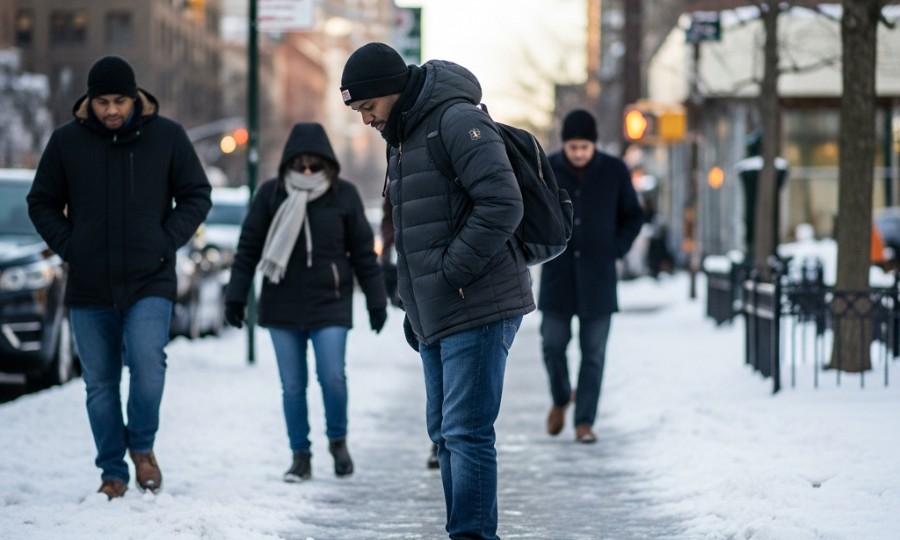
Imagine this: You’re walking down a familiar street in the Bronx, perhaps on your way to work or just running errands. It’s a typical New York winter day, snow falling gently, but suddenly, your feet go out from under you. You’ve hit a patch of ice, and before you know it, you’re on the ground, possibly injured. What happens next? Who’s responsible for clearing that ice, especially if the snow is still coming down?
This isn’t just a hypothetical scenario; it’s a harsh reality for many during our notoriously icy winters. And when it comes to liability for slip and fall accidents on snowy or icy sidewalks in New York, there’s a crucial legal concept you absolutely need to understand: the ‘storm-in-progress’ defense. It’s a doctrine that can significantly impact whether a property owner is held responsible for your injuries, and it’s far more nuanced than simply saying, ‘It was snowing, so no one’s at fault.’ We’re going to unpack this complex legal idea, explain what it means for Bronx residents, and empower you with the knowledge to navigate these tricky situations.
What Exactly is the “Storm-in-Progress” Doctrine in New York?
At its core, the ‘storm-in-progress’ doctrine in New York generally states that property owners aren’t responsible for injuries caused by slippery conditions on their property until a ‘reasonable time’ after a storm has ended. It makes sense, right? You can’t reasonably expect someone to continuously clear snow and ice while it’s still actively falling. It would be an impossible, Sisyphean task!
This legal principle acknowledges the practical challenges of snow removal during ongoing precipitation. Property owners, whether they’re commercial entities, landlords, or homeowners, are typically given a grace period to address the hazardous conditions once the storm has ceased. The rationale here is pretty straightforward: it’s simply not feasible to expect a completely clear sidewalk or parking lot when Mother Nature is still actively dumping snow or freezing rain. So, does this mean you’re out of luck if you slip during a blizzard? Not necessarily, and that’s where the nuances really come into play. It’s not a blanket immunity, but rather a delay in the duty to clear.
When Does the Storm “End”? Navigating the Nuances
You might wonder, what exactly constitutes the ‘end’ of a storm? Is it when the last snowflake falls, or when the sun finally peeks through? The truth is, New York courts have grappled with this question extensively, and it’s not always a clear-cut answer. Generally speaking, a storm is considered to be ‘in progress’ until precipitation has stopped for a reasonable period, allowing property owners to safely and effectively begin their clearing efforts. This isn’t just about the weather app saying ‘clear’; it can involve assessing factors like the cessation of precipitation, any subsequent refreezing, or even if conditions remain hazardous due to residual melting and freezing cycles.
Here’s the thing: determining when a storm truly ends isn’t always as simple as checking the weather forecast. Courts often look at hourly weather data, temperature changes, and whether the conditions would have allowed for safe and effective clearing. For example, in one notable case, a plaintiff slipped on ice hours after the last snowflake fell. The property owner tried to invoke the ‘storm-in-progress’ defense, but the court found that enough time had elapsed for them to have reasonably cleared the hazard, thereby making the defense inapplicable. This highlights a critical point: the clock starts ticking once the storm truly ceases, and ‘reasonable time’ isn’t forever.
Beyond the Storm: Property Owner Duties Even During Inclement Weather
While the ‘storm-in-progress’ defense offers some protection to property owners, it’s absolutely not an absolute shield against all liability. Even during an active storm, property owners still have a fundamental duty to not create or exacerbate dangerous conditions. This is a critical distinction, by the way. For instance, if a property owner attempts to clear snow during a storm but does so negligently, perhaps by piling snow in a way that creates an even more dangerous, icy patch, they could still be held liable if someone slips and falls on that created hazard. They can’t make things worse!
Think about it this way: shoveling snow and inadvertently creating a large, slushy pile that then freezes into a treacherous ice rink is different from simply having natural accumulation. The law doesn’t expect miracles during a blizzard, but it does expect a certain level of care to prevent new, man-made hazards from emerging. You might be thinking this won’t work because it’s hard to prove, but diligent documentation can make all the difference. This responsibility also extends to addressing pre-existing hazards that become more dangerous because of the ongoing storm, such as a known crack in the sidewalk that fills with water and then freezes solid. It’s about acting responsibly, even when the weather is at its worst.
What to Do if You’ve Slipped: Your Steps After an Icy Fall
If you’ve suffered a slip and fall injury on an icy sidewalk in the Bronx, especially if you suspect the ‘storm-in-progress’ defense might be a factor, knowing what to do immediately afterward is crucial. We know this feels overwhelming, but taking these steps can significantly impact your potential claim:
- Seek Medical Attention: Your health is paramount. Get checked out by a doctor, even if your injuries seem minor. Some injuries, like concussions or soft tissue damage, might not be immediately apparent.
- Document Everything: This is perhaps the most critical step. Take photos and videos of the exact location where you fell, showing the icy conditions, any surrounding snow, and the general state of the sidewalk. Capture the immediate aftermath, including any visible injuries. Note the date and precise time of your fall.
- Identify Witnesses: If anyone saw you fall, get their contact information. Their testimony can be invaluable.
- Note Weather Conditions: Pay close attention to the exact weather at the time of your fall, and in the hours leading up to it. Was it actively snowing? Had it stopped recently? This information is vital for assessing the ‘storm-in-progress’ defense.
- Report the Incident: If it’s a commercial property, report the fall to the management. If it’s a residential property, note down the address.
- Consult a Legal Professional: This is where things get really important. An experienced personal injury attorney who understands New York’s specific premises liability laws and the ‘storm-in-progress’ doctrine can evaluate your case, help gather evidence, and determine the best course of action. Don’t try to navigate this complex legal landscape alone.
The Bronx Context: Specific Challenges and Local Laws
For Bronx residents, understanding the ‘storm-in-progress’ doctrine also means being aware of local regulations. While the state doctrine sets a general framework, New York City, including the Bronx, has administrative codes that place specific responsibilities on property owners regarding sidewalk maintenance. For instance, the NYC Administrative Code generally requires property owners to clear snow and ice from sidewalks within a certain number of hours after the storm ceases, with different timeframes for daytime vs. nighttime storms. This isn’t just a suggestion; it’s a legal obligation.
Consider a busy thoroughfare in the Bronx, like a sidewalk near Fordham Road or Grand Concourse. Property owners in these high-traffic areas have an even greater impetus to ensure safety, not just because of the law but also because of the sheer volume of pedestrians. A diligent property owner would have a plan in place for snow removal, even if they’re waiting for the storm to pass. A negligent one, however, might simply ignore it, banking on the ‘storm-in-progress’ defense, which, as we’ve seen, isn’t a guaranteed shield. Knowing these local requirements adds another layer to your understanding of liability. Isn’t it empowering to understand your rights, even in the face of such complex legal doctrines?
Ultimately, navigating the legal complexities of a slip and fall injury, especially when the ‘storm-in-progress’ defense comes into play, can be incredibly challenging. It requires a deep understanding of New York’s laws, careful analysis of weather data, and often, expert testimony. If you or a loved one has been injured due to icy conditions in the Bronx, don’t assume your case is hopeless just because it was snowing. Reach out to a qualified attorney who can assess the specifics of your situation and advise you on your legal options. Your well-being and your rights matter, even when the snow is falling.
This article was drafted with AI assistance. Please verify all claims and information for accuracy. The content is for informational purposes only and does not constitute professional advice.
Free Consultation
We want to hear about your case! Fill in the form to speak to a Bronx personal injury attorney now!
Follow us for legal tips and case results:
