
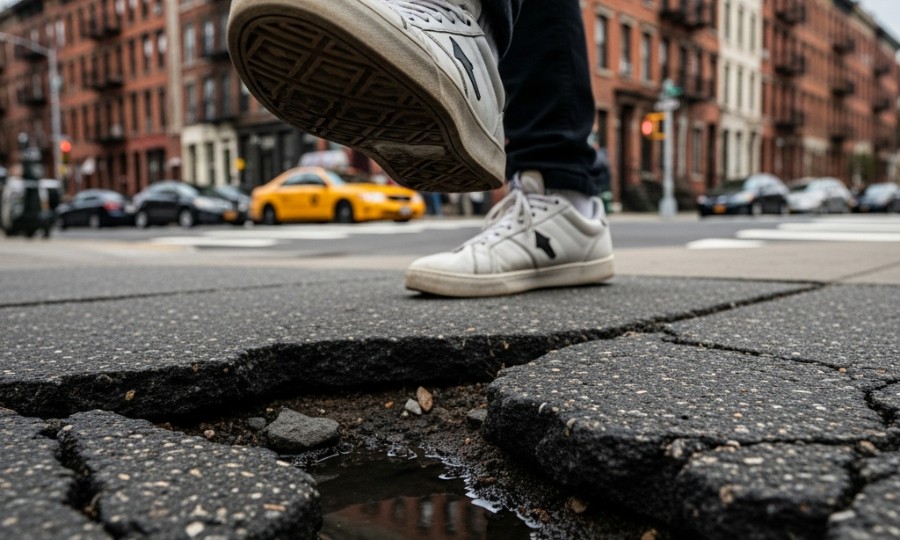
Navigating an injury claim against New York City can feel like battling a giant. Specifically, if you tripped on a sidewalk crack or hit a pothole in the Bronx, a unique legal challenge often arises. This challenge is known as the “prior notice” rule. Understanding this rule is absolutely essential for anyone pursuing a personal injury claim against the city for street or sidewalk defects.
Key Takeaways
- New York City’s ‘prior notice’ rule requires proof of written notification to the City about a road defect before an accident; without it, claims for defects might face significant challenges.
- Valid prior notice typically involves a formal 311 complaint or DOT inspection report specific to the defect’s location, and can sometimes be found through FOIL requests.
- Victims have only 90 days from the accident date to file a Notice of Claim against NYC, a critical deadline that, if missed, can permanently bar recovery.
- Recoverable damages in successful claims include medical expenses, lost wages, and pain and suffering, often totaling tens of thousands of dollars or more depending on injury severity.
Our Bronx personal injury lawyers have decades of experience helping accident victims. We know firsthand how challenging it is to prove the city knew about a hazard before your accident. This rule requires you to show the City of New York had prior written notice of the dangerous condition. Without this proof, your case might not proceed. Also, victims often feel overwhelmed by this complex requirement. We aim to demystify it and guide you through the process.
Understanding New York City’s Prior Notice Rule
The prior notice rule is codified in Section 7-201(c)(2) of the New York City Administrative Code. Essentially, this law creates a conditional liability shield for NYC regarding street and sidewalk defects, requiring prior written notice, but does not provide blanket protection from liability for all defects. These defects include potholes, cracked sidewalks, and other hazardous street conditions. The city is not liable unless it received specific written notice of the defect. This notice must be given before an accident occurs.
Therefore, simply proving a dangerous pothole caused your injury is not enough. You must also demonstrate that the City received a formal complaint. This complaint must detail that specific defect. This requirement applies to various types of public property defects. For example, it covers uneven sidewalks, missing manhole covers, or broken street lights.
What Constitutes Valid Prior Written Notice?
Prior written notice is very specific. It is not just any mention of a problem. Generally, there are a few primary ways the City receives this official notice.
First, a formal complaint filed with the Department of Transportation (DOT) is a strong form of notice. These complaints are often recorded in databases. Similarly, a report made to the 311 service center can count. However, the report must clearly describe the exact location and nature of the defect.
Second, the City itself might create a record of a defect. This happens during inspections. For instance, if a DOT crew surveyed a street and noted a large pothole, that record serves as prior notice. These internal records are crucial. Consequently, our team thoroughly investigates city records for such evidence.
Third, a notice of claim filed by another injured party might also serve as notice. If someone else filed a claim for the same pothole before your accident, that document could be vital. This situation is less common but still possible. Therefore, extensive investigation is often necessary.
The Challenge of Proving Prior Notice
Proving prior written notice presents significant hurdles. The City of New York does not readily admit fault. They often defend these cases vigorously. Many claims fail because victims cannot produce the required documentation. Therefore, a thorough and timely investigation is paramount.
For example, imagine you tripped on a severely cracked sidewalk in Fordham. You might assume the city knew about it due to its obvious condition. However, without a formal written complaint filed previously, your claim faces an uphill battle. This is a common misunderstanding among accident victims. Our injury attorneys in the Bronx handle car, construction, and slip-and-fall cases. We regularly encounter this prior notice issue.
Also, the exact location is critical. A complaint about a pothole on one block does not count as notice for a pothole on a different block. Even if the defects are similar, the specificity is non-negotiable. This precision demands meticulous evidence gathering.
How Our Firm Gathers Prior Notice Evidence
Successfully navigating the prior notice rule requires a systematic approach. Our legal team employs several strategies to uncover the necessary evidence. We understand the specific documents and databases to search.
Initially, we file Freedom of Information Law (FOIL) requests. FOIL requests create a legal obligation for agencies to provide access to non-exempt records, but agencies may withhold records under statutory exemptions and denials are subject to administrative and judicial review. We seek out 311 complaints, DOT inspection reports, and maintenance schedules. Also, we examine records from various agencies that might have conducted work in the area, creating relevant documentation.
Plus, we analyze city mapping data. Sometimes, public works projects or utility repairs reveal prior knowledge of underlying street conditions. We also look for evidence of repeated repairs. Frequent repairs might indicate a recurring issue known to the City. This can sometimes establish a pattern of notice.
Finally, we consult with experts. These experts might include engineers or accident reconstructionists. They can help determine if a defect was long-standing and should have been noticed. Their professional opinions strengthen your case. Consequently, we build the strongest possible argument for prior notice.
Exceptions to the Prior Notice Rule
While strict, the prior notice rule does have limited exceptions. These exceptions are rare but important to understand. They can provide an alternative path to holding the City accountable.
One key exception applies when the City itself created the dangerous condition. For instance, if a city work crew improperly repaved a road, creating an immediate hazard, prior notice might not be required. The City cannot claim ignorance of a condition it directly caused.
Another exception involves situations where the City performed work in the immediate vicinity. If city workers were performing repairs near a defect and should have reasonably discovered it, the rule might be bypassed in some circumstances. This is often referred to as “constructive notice.” However, proving this often requires extensive documentation and witness testimony. Therefore, robust legal representation is vital.
However, these exceptions are narrowly interpreted by the courts. You cannot simply assert them. You must provide clear evidence supporting the exception. Many claims falter without precise legal argumentation. Our experience helps identify and pursue these limited opportunities.
The Importance of Timely Action
If you suffered an injury due to a street or sidewalk defect, acting quickly is critical. New York law imposes strict deadlines for filing claims against municipal entities. You typically have only 90 days from the date of the accident to file a Notice of Claim. Missing this deadline can permanently bar your ability to recover damages. Plus, delaying your actions makes gathering evidence much harder.
Witness memories fade over time. Physical evidence like the defect itself might be repaired. Therefore, immediate action preserves crucial details. Also, prompt investigation allows our team to begin the extensive search for prior notice documentation right away. We start working to build your case from day one.
What Damages Can You Recover?
Successfully proving prior notice opens the door to recovering various damages. These damages aim to compensate you for your losses. They cover both economic and non-economic harm. Our goal is to secure full and fair compensation for every client.
Economic damages include medical expenses. This covers hospital bills, doctor visits, physical therapy, and prescription costs. Also, lost wages are recoverable. If your injuries prevented you from working, you can claim these lost earnings. Future medical costs and lost earning capacity are also considered.
Non-economic damages address your pain and suffering. This includes emotional distress, disfigurement, and loss of enjoyment of life. These damages are harder to quantify but are a significant component of many personal injury claims. A skilled attorney understands how to properly value these losses.
Choosing the Right Bronx Personal Injury Lawyer
Selecting an experienced legal team is paramount for a successful claim. The intricacies of the prior notice rule demand specific knowledge and resources. A lawyer unfamiliar with these requirements will struggle to build a strong case. Therefore, choose wisely.
Our firm has a deep understanding of New York City’s complex legal landscape. We have successfully represented countless Bronx residents against the City. We know how to investigate, gather evidence, and negotiate with municipal attorneys. Our commitment is to our clients. Also, we fight tirelessly to protect your rights.
We offer a free consultation. This allows us to discuss your case and explain your options without any upfront cost. We operate on a contingency fee basis. This means you pay no legal fees unless we secure compensation for you. This arrangement ensures access to justice for everyone.
If you need an experienced Bronx accident lawyer, our firm is ready to fight for you. We understand the challenges you face. We are here to provide the compassionate and authoritative legal guidance you deserve. Do not let the prior notice rule deter you from seeking justice. Contact us today to learn how we can help.
Related Reading
Frequently Asked Questions
What is the ‘prior notice’ rule for NYC pothole claims?
The ‘prior notice’ rule, under Section 7-201(c)(2) of the NYC Administrative Code, states that the City is not liable for injuries from road defects like potholes unless it received specific written notice of that defect before the accident. This means you must prove the city knew about the exact hazard.
How do I prove New York City had prior notice of a road defect?
Proving prior notice often involves finding official 311 service requests, Department of Transportation (DOT) inspection reports, or other city records documenting the specific defect. Our firm frequently uses Freedom of Information Law (FOIL) requests to uncover these crucial documents.
Are there any exceptions to the prior notice rule in New York City?
Yes, there are limited exceptions. If the City of New York directly created the dangerous condition, or if city workers performing nearby work should have reasonably discovered it, prior notice might not be required. However, these exceptions are strictly interpreted and require robust evidence.
What is the deadline for filing a claim against New York City for an injury?
If you are injured due to a street or sidewalk defect in New York City, you generally have only 90 days from the accident date to file a formal Notice of Claim. Missing this critical deadline can result in the permanent loss of your right to seek compensation.
This article was drafted with AI assistance. Please verify all claims and information for accuracy. The content is for informational purposes only and does not constitute professional advice.
Free Consultation
We want to hear about your case! Fill in the form to speak to a Bronx personal injury attorney now!
Follow us for legal tips and case results:
